CULTURE / A WAY OF SEEING
The visible.
The suggested.
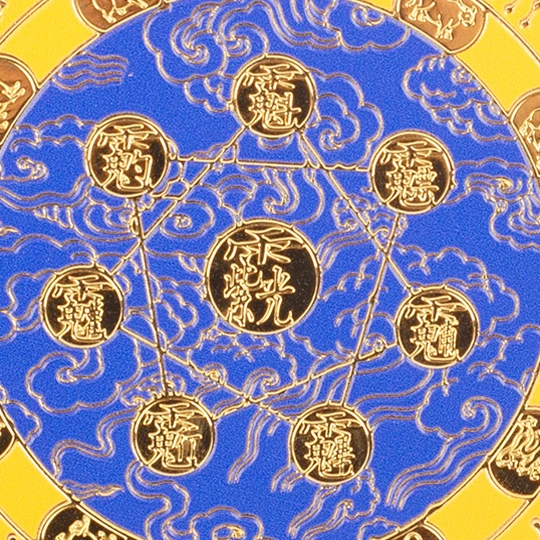
A circle. A divided line. Seven connected points. Chinese cultural forms invite attention to relationships as well as individual marks.
Read the visual languageOriginal reverse detail · partial view
01 / THE EIGHT TRIGRAMS
Three lines.
Eight forms.
Whole and divided lines form a precise visual vocabulary. The encounter starts by noticing how they are arranged.
Each trigram brings three lines together. A line may be whole or divided; the combinations produce eight forms. In the Yijing tradition, these forms are associated with images such as heaven, earth, water and fire.
On an object, a trigram may sit within a larger composition of circles, inscriptions and other motifs. Looking closely means keeping those relationships in view. A symbol is more than an isolated decorative mark, yet its appearance alone cannot tell the entire history of a piece.
02 / FOUR WAYS TO LOOK
A language of
visible and unseen.
I. The trigram
Whole and divided lines. A small vocabulary capable of holding many relationships.
II. The inscription
Marks that invite a closer reading. Their place on the object is part of the composition.
III. The surface
Copper beneath a plated finish; colour defining a motif. Matter gives the image its presence.
IV. The reverse
A second face changes the first impression. Turn the object; let another rhythm appear.
03 / THE CELESTIAL IMAGE
The heavens,
made visible.
Star imagery gives a surface an order that can be followed. The connected points on the Doumu handle and the roundels on Guangming Mirror offer two different examples within this collection.
Chinese art has also pictured celestial bodies as figures. The Metropolitan Museum of Art’s Divinities of the Planets and Constellations, attributed to Qiu Ying, depicts the deities of five planets and twenty-eight constellations. That historical painting provides wider context, rather than a provenance claim for these contemporary objects.
Collection reference: The Metropolitan Museum of Art, object 1989.235.4 ↗